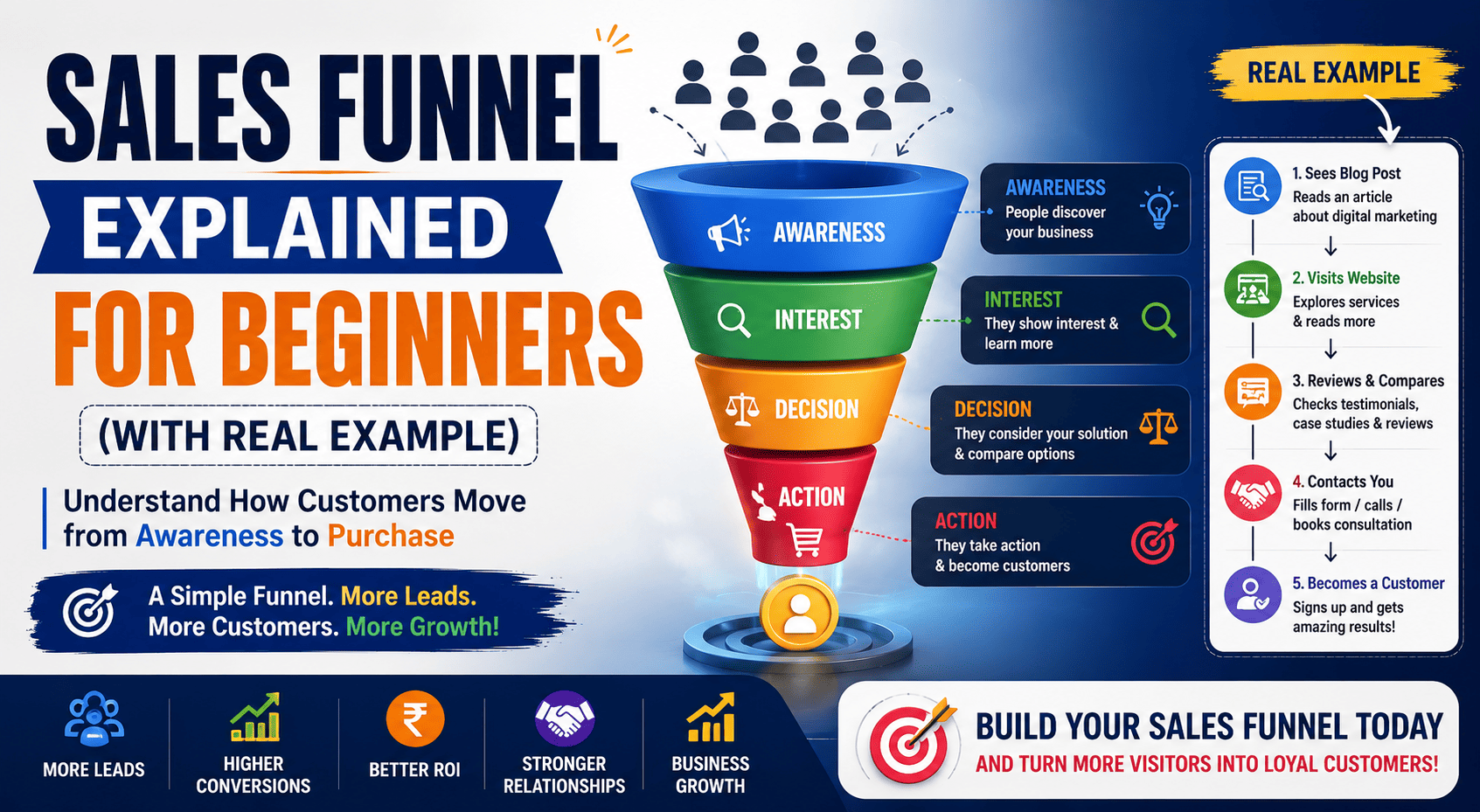
If you've ever wondered why some businesses consistently generate leads and sales while others struggle to convert website visitors into customers, the answer often lies in their sales funnel.
A sales funnel is one of the most important concepts in marketing and business growth. Whether you're running a digital marketing agency, educational institute, hotel, eCommerce store, real estate company, or local business, understanding the sales funnel can help you attract more customers and increase revenue.
Many beginners assume that sales happen instantly. In reality, customers usually go through several stages before making a purchase decision. A sales funnel helps businesses guide potential customers through this journey.
In this guide, we'll explain the sales funnel in simple terms, break down each stage, and show a real example so you can understand exactly how it works.
What Is a Sales Funnel?
A sales funnel is the journey that potential customers take from discovering your business to becoming paying customers.
It's called a funnel because many people enter at the top, but only a smaller percentage reach the bottom and make a purchase.
For example:
1,000 People See Your Advertisement
↓
300 Visit Your Website
↓
100 Contact You
↓
30 Request a Quote
↓
10 Become Customers
This process represents a sales funnel.
Without a sales funnel, businesses often lose potential customers because they don't have a structured process for converting leads into sales.
Why Is a Sales Funnel Important?
A sales funnel helps businesses:
• Understand Customer Behavior
• Increase Conversion Rates
• Generate More Leads
• Improve Marketing ROI
• Reduce Customer Acquisition Costs
• Increase Sales Revenue
Instead of guessing what customers want, a funnel helps you create a predictable system for growth.
The Four Main Stages of a Sales Funnel
Most sales funnels consist of four major stages:
1. Awareness
2. Interest
3. Decision
4. Action
Let's understand each stage in detail.
Stage 1: Awareness
This is the top of the funnel.
At this stage, potential customers discover your business for the first time.
They may find you through:
• Google Search
• Facebook Ads
• Instagram Reels
• YouTube Videos
• Blog Articles
• Referrals
The customer doesn't know much about your business yet.
Your goal here is to grab attention.
Example:
A business owner searches:
"How to get more leads online"
They find your blog article or social media post.
Congratulations—you've entered the Awareness Stage.
Best Marketing Channels for Awareness
• SEO
• Content Marketing
• Social Media Marketing
• YouTube Marketing
• Google Ads
• Facebook Ads
Stage 2: Interest
Now the customer is interested in learning more.
They begin researching your services, reading content, comparing options, and exploring solutions.
At this stage, they may:
• Visit Your Website
• Read Blogs
• Watch Videos
• Follow Your Social Media Pages
• Download Free Resources
Your goal is to build trust and educate the customer.
Example:
The business owner visits your website and reads several articles about digital marketing.
They're not ready to buy yet, but they are interested.
How to Increase Interest
• Publish Helpful Content
• Share Case Studies
• Offer Free Guides
• Create Educational Videos
• Send Email Newsletters
Stage 3: Decision
This is where potential customers compare different businesses before making a final choice.
They evaluate:
• Pricing
• Reviews
• Testimonials
• Experience
• Results
• Customer Support
At this stage, trust becomes extremely important.
Example:
The business owner compares your agency with three competitors.
They check:
• Your Portfolio
• Client Reviews
• Google Ratings
• Service Packages
If your business appears trustworthy, you'll move them closer to purchase.
Ways to Improve Decision-Making
• Display Testimonials
• Showcase Case Studies
• Offer Free Consultations
• Highlight Success Stories
• Explain Your Process Clearly
Stage 4: Action
This is the bottom of the funnel.
The customer finally takes action.
Examples:
• Purchases a Product
• Books a Hotel Room
• Enrolls in a Course
• Requests a Quote
• Signs a Contract
At this point, your marketing efforts have successfully converted a lead into a customer.
Example:
The business owner schedules a consultation and hires your agency.
The sale is complete.
Real Sales Funnel Example
Let's understand a real-world example using a Digital Marketing Agency.
Step 1: Awareness
Talk2Market publishes a blog titled:
"Why Your Website is Not Generating Leads"
A business owner finds the article through Google.
Step 2: Interest
The visitor reads the article and explores other pages on the website.
They visit:
• SEO Services Page
• Google Ads Page
• About Us Page
Step 3: Decision
The visitor sees:
• Client Testimonials
• Case Studies
• Success Stories
They become confident in the agency's expertise.
Step 4: Action
The visitor fills out a contact form or calls the agency.
They become a lead.
After consultation, they become a paying client.
This is a complete sales funnel in action.
Top of Funnel (TOFU)
TOFU stands for Top of Funnel.
Goal:
Generate Awareness
Content Examples:
• Blog Posts
• Social Media Content
• Educational Videos
• SEO Content
Audience:
People who are discovering your business.
Middle of Funnel (MOFU)
MOFU stands for Middle of Funnel.
Goal:
Build Trust & Interest
Content Examples:
• Case Studies
• Webinars
• Free Resources
• Email Marketing
Audience:
People considering your solution.
Bottom of Funnel (BOFU)
BOFU stands for Bottom of Funnel.
Goal:
Generate Sales
Content Examples:
• Free Consultation
• Product Demo
• Pricing Pages
• Customer Reviews
Audience:
People ready to buy.
Common Sales Funnel Mistakes
No Lead Capture System
Many businesses fail to collect visitor information.
Weak Call-To-Action
Visitors don't know what to do next.
No Follow-Up Process
Businesses often lose leads because they never follow up.
Poor Website Experience
Confusing websites reduce conversions.
Lack of Trust Signals
Without reviews and testimonials, visitors hesitate to buy.
How to Build a Sales Funnel for Your Business
Step 1:
Attract Visitors
Use:
• SEO
• Blogs
• Social Media
• Paid Advertising
Step 2:
Capture Leads
Use:
• Contact Forms
• WhatsApp Chat
• Free Downloads
• Consultation Requests
Step 3:
Build Trust
Use:
• Email Marketing
• Case Studies
• Testimonials
• Helpful Content
Step 4:
Convert Leads
Offer:
• Free Consultation
• Demo
• Proposal
• Special Offer
Step 5:
Retain Customers
Focus on:
• Customer Support
• Follow-Up
• Upselling
• Referrals
Benefits of Having a Sales Funnel
A well-designed sales funnel helps businesses:
✓ Generate More Leads
✓ Increase Conversions
✓ Improve Customer Experience
✓ Increase Revenue
✓ Build Brand Trust
✓ Scale Faster
Instead of relying on random inquiries, businesses gain a predictable and repeatable system for growth.
How Talk2Market Helps Businesses Build High-Converting Sales Funnels
At Talk2Market, we help businesses create sales funnels that turn website visitors into paying customers.
Our services include:
• Funnel Strategy
• Landing Page Design
• Lead Generation Campaigns
• Google Ads
• Facebook Ads
• SEO Services
• Conversion Optimization
• Email Marketing
Our goal is to help businesses generate consistent leads and maximize their return on investment.
Conclusion
A sales funnel is one of the most powerful tools for business growth. It helps businesses understand the customer journey and systematically move prospects from awareness to purchase.
Whether you're a startup, local business, educational institute, hotel, or digital marketing agency, implementing a structured sales funnel can dramatically improve lead generation and sales performance.
The businesses that grow consistently aren't necessarily the ones with the biggest budgets—they're the ones with the best systems. A well-optimized sales funnel is one of those systems.
Q. What is a sales funnel?
A. A sales funnel is the journey customers take from discovering your business to becoming paying customers.
Q. Why is a sales funnel important?
A. It helps businesses generate more leads, improve conversions, and increase revenue through a structured customer journey.
Q. What are the stages of a sales funnel?
A. Awareness, Interest, Decision, and Action.
Q. What is TOFU, MOFU, and BOFU?
A. TOFU is Top of Funnel (Awareness), MOFU is Middle of Funnel (Interest), and BOFU is Bottom of Funnel (Conversion).
Q. Can small businesses use sales funnels?
A. Yes. Sales funnels are beneficial for businesses of all sizes and industries.